Accel leads $18M Series A for Knoetic, a startup that wants to make HR professionals’ lives easier with software
Knoetic, a startup that has built a software analytics platform for chief people officers, emerged from stealth today with $18 million in Series A funding.
For the unacquainted, chief people officers are also known as heads of human resources, or HR.
Accel led the financing, which notably also included participation from over 100 angel investors, including a number of executives, VCs and former and current chief people officers (CPOs) of companies such as Mozilla, Pinterest, Gusto, Box, Twilio, Fitbit, Kickstarter, Looker, Hired and GitHub.
For founder and CEO Joseph Quan, the fact that so many people who worked in the industry put money in the round as angels was huge validation that Knoetic is on the right track.
Founded in March 2020, the New York City-based startup has built a platform that combines a social network and a SaaS analytics tool for chief people officers. When the COVID-19 pandemic hit last year, human resources leaders found themselves in a position they’d never before been — hiring talent remotely and having to work virtually to retain workers that previously came to an office.
Quan himself has worked in a variety of roles in the HR technology space, including at Twine, Knoetic’s predecessor company.

Image Credits: Knoetic; Founder and CEO Joseph Quan
“The reason we exist was really born out of the pandemic. We noticed in our ecosystem of chief people officers that their role was thrust into the spotlight and it was a really tough time for them, and also a really lonely time,” Quan told TechCrunch. “Everyone was kind of scrambling for answers and we just realized this was a time to actually put together a network that allows all these people to commiserate and tackle some of their hardest questions, and then from that, form the basis for a broader vision.”
Over 1,000 HR professionals are members of Knoetic’s social community, which the company has embedded directly into its people analytics software. The result, Quan said, is an “Insight Engine” designed to give CPOs both quantitative and qualitative insights with the goal of helping them make “smarter, holistic” decisions about their workforce. The network is a referral-only community aimed at giving HR professionals a forum to discuss best practices and their “most pressing challenges,” such as how to navigate the COVID Delta variant and transition to and from remote work, Quan said.
Chief people officers can also use Knoetic to do things like build board decks and present data to their CEOs. The company also claims the platform can help CPOs improve employee retention, compensation and hiring.
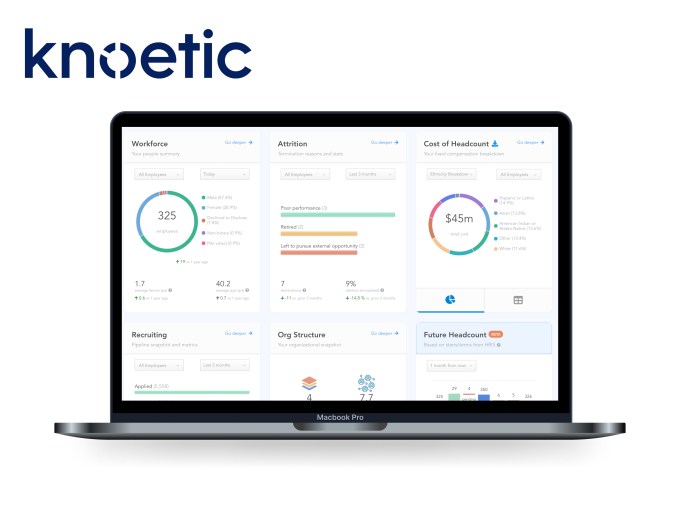
Image Credits: Knoetic
In a short amount of time, Knoetic has built an impressive customer and community base, including the likes of Lyft, Squarespace, Amplitude, Discord, Dollar Shave Club and Zapier.
Vas Natarajan of Accel believes that Knoetic is solving “a deep pain point.”
“We see how overstretched people teams are trying to wrangle information to make organizational decisions,” he wrote via email. “Across our best companies is a strong people function backed by great data to help inform all kinds of decisions around compensation, performance, and diversity and inclusion, among other things. Knoetic is uniformly solving this for everyone.”
The startup will use its new capital toward building out new products and hiring. It currently has about 25 employees, and Quan expects that number to grow to “north of 40” by year’s end.
“We want to build the single greatest network for HR professionals and build a dedicated community team,” he said.
Down the line, Quan also envisions creating an analytics engine that is “prescriptive and predictive” and can do things like tell HR leaders what kind of turnover their companies are seeing, what they can do about it and how to improve retention.
“And then it would be predictive as we gather more big data points as more people use the platform,” he added. “Then we could use that data to proactively predict who’s going to be a fast-rising company or who’s going to trip over the next 12 months. We’re starting to build those kinds of models on the back end.”

from Startups – TechCrunch https://ift.tt/3sN6chV
Comments
Post a Comment