An app that has the needs of modern-day parents in mind, Winnie, has now raised $4 million in additional seed funding in a round led by Reach Capital. Other investors in the new round include Rethink Impact, Homebrew, Ludlow Ventures, Afore Capital, and BBG Ventures, among others. With the new funds, Winnie has raised $6.5 million to date.
The San Francisco-based startup, which begun its life as a directory of kid-friendly places largely serving the needs of newer parents, has since expanded to become a larger platform for parents.
Winnie was founded by Bay Area technologists, Sara Mauskopf, who spent time at Postmates, Twitter, YouTube and Google, and Anne Halsall, also from Postmates and Google, as well as Quora and Inkling.
As new parents themselves, they built Winnie out a personal need to find the sort of information parents crave – details you can’t easily dig up in Google Maps or Yelp.
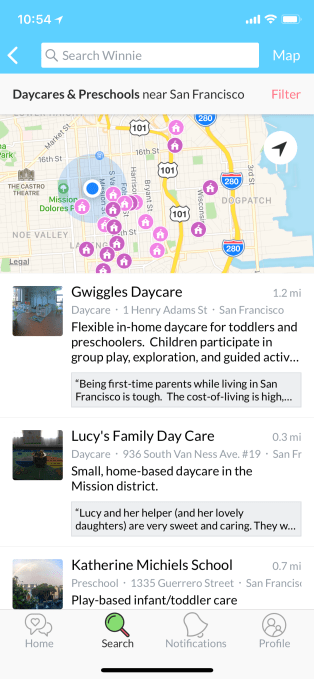
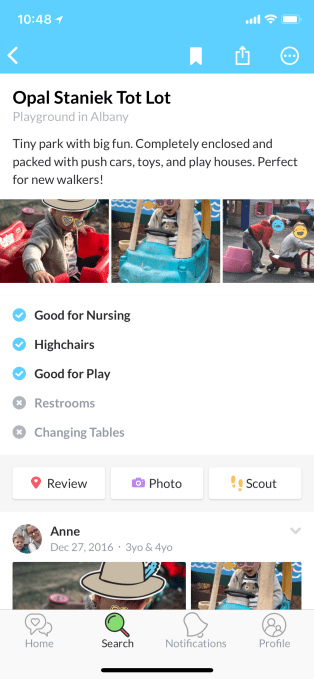
For example, you can use Winnie to find nearby kid-friendly destinations like museums or parks, as well as those that welcome children with features like changing tables in restrooms, wide aisles in stores for stroller access, areas for nursing, and other things.
"Babies are people too, and they deserve a designated clean bathroom space just like the rest of us."
https://t.co/Ps8egQcDLL
— Winnie (@Winnie) June 5, 2018
Winnie serves as a good example of what investing in women can achieve. Somehow, the young, 20-something men that receive the lion’s share of VC funding had never thought up the idea of app that helps new parents navigate the world. (I know, shocking, right?) And yet, the kind of questions that Winnie tries to answer are those that all parents, at some point, are curious about.
The data on Winnie is crowd-sourced, with details, ratings and reviews coming from other real parents. Listings in San Francisco may be more fleshed out than elsewhere, as that’s where Winnie got its start. However, the app is now available in 10,000 cities across the U.S., and has just surpassed over a million users.
In more recent months, Winnie has been working to expand beyond being a sort of “Yelp for parents,” and now features an online community where parents can ask questions and participate in discussions.
“The crowdsourced directory of family-friendly businesses is still a huge component of what we do…and this has grown to over 2 million places across the United States,” notes Winnie co-founder and CEO Sara Mauskopf. “But we also have these real-time answers to any parenting question from this authentic, supportive community,” she says, referring to Winnie’s online discussions.
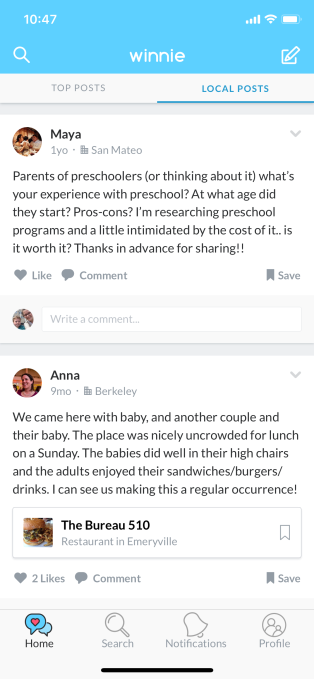
The idea is that parents will be searching the web for answers to questions about toddler sleep issues or good local preschools or breastfeeding help, and Winnie’s answers will come up in search results, similar to other Q&A sites like Quora or Yahoo Answers.
“A lot of younger millennial parents are turning to Google to find answers to these questions,” adds Winnie co-founder and CPO Anne Halsall. “So we want to have the answer to these questions at the ready, and we want to have the best page. That’s an example of something that’s yield a lot of traffic for us, just because no one else had that data before Winnie,” she says.
Related to this expansion, Winnie is also serving this data across platforms, including – obviously – the web, in addition to its native app on iOS and Android. The hope is that, with the growth, business owners will come in to claim their pages on Winnie.com, too, and update their information.
In the near-term, the founders say they’ll put the funding to use building out more personalization features.
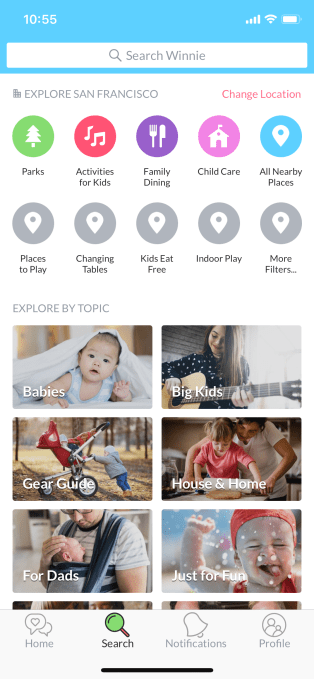
“As a technology company, we have a unique opportunity to give you this really tailored experience that grows with your family over time – so as your children are getting older, and you’re entering new phases of development, our product’s adapting and putting relevant information in front of you,” Halsall says.
Data on businesses serving the needs of parents with older kids – like summer camps or driver’s ed classes, for example – are the kind of things Winnie will focus on as it grows to include information for more parents, instead of just those with younger children and babies.
Winnie will also use the funds to hire additional engineers to help it scale its platform.
Esteban Sosnik from Reach Capital joined Hunter Walk from Homebrew on Winnie’s board as a result of the funding.
The app is a free download for iOS and Android, and is available on the web at Winnie.com.

from Startups – TechCrunch https://ift.tt/2yGnGUI
Comments
Post a Comment