Mobile landing page builder Beacons has raised a $6 million seed round to expand its vision for empowering creators to make money beyond the cramped confines of their social media profiles. The company, co-founded by Neal Jean, Jesse Zhang, Greg Luppescu and David Zeng, provides anyone who uses social media a single, mobile-optimized link hub to display to their followers.
Like competitor Linktree, Beacons gives people a way to link out to other sites directly from their TikTok, Instagram or Twitter profile, including pointing followers toward potential income streams like donations and affiliate links. Other companies in the “link in bio” space include Shorby, Milkshake, Tap.bio, Link in Profile, bio.fm and Campsite.
Beacons launched in private beta in September 2020 after emerging out of Y Combinator’s Summer 2019 cohort. Andreessen Horowitz will lead the seed round and is joined by Atelier Ventures, The Chainsmokers’ Mantis Fund, Night Media Ventures and LOUDgg, the Brazilian esports group.
The $6 million seed round will build on $600,000 that Beacons raised in an angel round, allowing the team to hire more engineers and designers to grow its small four-person team of first-time founders.
“I think where we’re really different than Linktree is we let creators customize and personalize their pages all for free and we offer a lot more of those options on our free plan,” Beacons co-founder and CEO Neal Jean told TechCrunch.
“…Creators care a lot about how their website looks so that’s been a good way for us to give creators the features that they want and help us grow our share in the market too.”
To keep creators locked into their own platforms and forthcoming monetization schemes, social media companies don’t offer much support for embedded links, particularly on individual pieces of content. Many also restrict users to one URL in their profiles, putting pressure on creators to maximize the utility of a single link. Beacons reasonably argues that the restrictive design of most social platforms stunts the ability of creators to easily and flexibly make money from their content.
“In the beginning we’re basically building all these different kinds of features for creators to use but I think in the long run the way to make that more scalable is to turn into more of a platform or an ecosystem that lots of people can build on,” Jean said.
“Today, I think we’re probably more like a Wix or a Squarespace for content creators, but in the future I think we want to be a little bit more like Shopify for creators.”
Building on Beacons
Beacons lets users choose between free and premium tiers. At $10 per month, the “entrepreneur” tier offers a couple of killer features worth considering, including support for custom domains and additional “blocks” — the link, text and image slots that comprise a Beacons page.
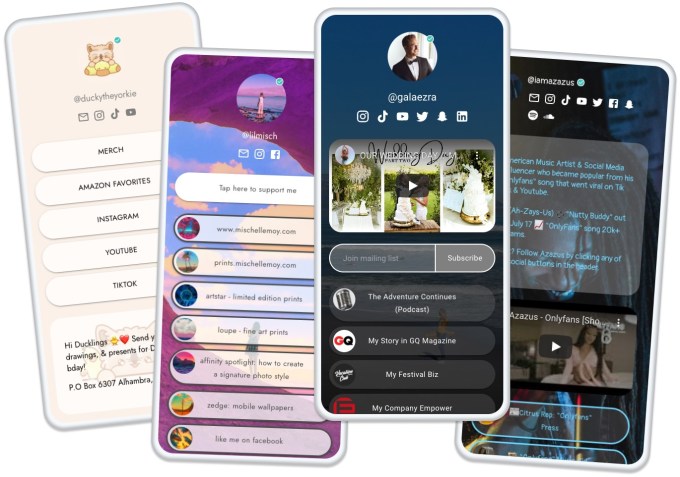
Image Credits: Beacons
Beyond premium pricing, Beacons makes money by taking a cut of sales through its handful of monetization-focused blocks, like a shopping-enabled TikTok feed, a digital storefront for videos and e-books and a “requests” block that lets creators sell custom content directly to their followers. Beacons’ free plan charges a 9% fee on transactions, while the premium plan cuts that down to 5%.
Landing sites built through Beacons are deeply customizable, hearkening back to the Myspace era of media-rich, curated homepages. The company recently added what it calls the “community block,” a designated place where creators can highlight collaborators they might team up with often on a collab-obsessed platform like TikTok. The company currently counts Sia, Green Day and Russell Brand among its high-profile users.
Beacons also supports mobile marketing through email and SMS and analytics to help creators understand their audiences. The company says that its user base has grown by 70% every month since its October launch.
“Today’s content creators and consumers have more sophisticated expectations than existing social platforms allow,” Jean said in the funding announcement. “…With Beacons, creators can control their destiny by directing online traffic to a custom domain that looks awesome, is shareable and ultimately generates revenue.”

from Startups – TechCrunch https://ift.tt/3ugdiKQ
Comments
Post a Comment